Get the chance to win £100 alongside trusted feeding advice, helpful tips and the latest deals and competitions straight to your inbox.

At 6 weeks pregnant, you’re already halfway through your first trimester - even though you might have only just found out that you’re pregnant (that first missed period is a real giveaway!).
There are plenty of changes happening for you and your baby as their tiny body develops and your changing pregnancy hormones lead to some more noticeable early 6 weeks pregnant symptoms.
Let’s take a look at what you can expect, including tiredness, cramps, headaches and any bleeding at 6 weeks pregnant.
Reviewed by Sammy, a registered NHS midwife with a background in neonatal nursing, dedicated to providing compassionate, evidence based care to women and families throughout pregnancy, birth and the postnatal period.
Your baby’s development
Your baby is not yet called a foetus at 6 weeks (they’re still an embryo up until around week 8 of your pregnancy1, but they’re doing lots of growing and developing, even at this early stage.
If you could zoom in and see your baby up close, you’d notice two little bumps – one where their heart will be, and one that will become their head and brain. You’d also see some tiny swellings called limb buds that will develop into arms and legs, and dimples that will become their eyes and ears2.
You might be offered a 6-week scan if there’s a reason to check your baby’s development, for example, if you’ve had complications in a previous pregnancy, have undergone IVF, or have experienced some bleeding3,4. If you have a 6-week scan, it will be with a transvaginal ultrasound, and you might be able to see their heart beating5.
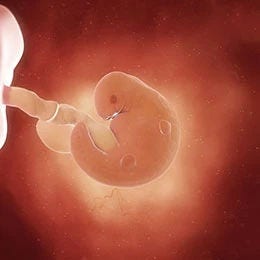
How big is my baby at 6 weeks pregnant?
At 6 weeks pregnant, your baby is just 6mm long, or around the size of a pea. They look a little like a tadpole right now, with a curved tail4.
You and your body at 6 weeks pregnant
Your body is amazing, changing and adapting to meet the needs of your growing baby at every step of your pregnancy.
While your baby’s still this tiny, you probably won’t have a visible baby bump – you’ll likely start to show in your second trimester (especially if this is your first baby). That means that, for now, it’s still safe for you to sleep on your back or stomach. Later in your pregnancy, especially in your third trimester, it’s safest to sleep on your side6.
6 weeks pregnant: symptoms to look out for
At 6 weeks pregnant, you might be starting to notice some of those tell-tale early pregnancy symptoms. For example, a missed period, feeling more tired than usual, sore breasts and feeling sick (otherwise known as morning sickness7).
You might also start to go off some of your favourite foods, develop a taste for things you don’t usually like, which could be the beginnings of those much-talked-about pregnancy cravings7.
Have a look at some of the other 6 weeks pregnant symptoms that could be making themselves around about now.
Cramps
It’s common to notice a few mild cramps at 6 weeks pregnant - they may be similar to period cramps. Usually, they’re caused by your changing hormones and ligament pains in your growing womb8. Cramps might also be down to constipation or trapped wind.
Spotting and bleeding
Some spotting or very light bleeding at 6 weeks pregnant can be normal. It’s often called implantation bleeding as it happens when your baby (embryo) embeds itself in the wall of your womb9.
Implantation bleeding often happens around the same time as you’d usually get your period but tends to stop after 1 or 2 days10. If you’re 6 weeks pregnant and experiencing heavier bleeding that doesn’t stop, contact the maternity assessment unit to speak with a midwife.

Get the chance to win £100 alongside trusted feeding advice, helpful tips and the latest deals and competitions straight to your inbox.
By registering you're confirming you agree with our T&Cs and Privacy Policy. You can opt out anytime.
When to get help for cramping or bleeding in early pregnancy
Most cramping and spotting are harmless, but occasionally, it can be a sign of a complication with your pregnancy.
Contact your GP or midwife if8:
- You have pain when you pee, or blood in your urine
- You have vaginal discharge that’s unusual for you
- The pain is severe and doesn’t go away
- You have a fever
Headaches
Headaches are another common early pregnancy symptom at 6 weeks. They usually improve with time, but it’s usually safe to take paracetamol for the pain if you need to. Speak to your doctor or pharmacist before taking any painkillers while pregnant and always follow the instructions on the packet11.
If you have a very painful headache along with problems with your vision or swelling in your face, feet, or hands, it could be a sign of pre-eclampsia, and you should get in touch with your midwife or GP straight away11.
Feeling bloated
Your progesterone levels increase in early pregnancy to support your growing baby. Progesterone can also affect your digestive system and cause pregnancy symptoms like heartburn, bloating and constipation12.
If you’re feeling bloated at 6 weeks pregnant, try to pack plenty of fibre into your diet to help keep things moving, and eat smaller meals more often to avoid feeling too full13,14.
Darkened skin
You might notice patches of darker skin on your face at 6 weeks pregnant, caused by your changing hormones15. You might hear it being called melasma, chloasma, or the mask of pregnancy. Once your baby arrives, your skin will likely return to its usual colour and tone.
Vitamins during early pregnancy at 6 weeks pregnant
During early pregnancy, it’s important to get the vitamins and minerals that you and your growing baby need to stay healthy.
As well as eating a healthy and balanced diet , you’re advised to take 400 micrograms of folic acid every day for the first 12 weeks of pregnancy16. Folic acid helps your baby’s spine and brain to develop normally and can reduce the risk of defects like spina bifida17.
Vitamin D is also very important as your baby grows and develops. Experts recommend taking a daily vitamin D supplement during pregnancy right up until your baby is born16. If you’re pregnant or breastfeeding, you can get free vitamin D supplements through the Healthy Start Scheme. Find out if you qualify here.
FAQs at 6 weeks pregnant
Yes! Some mums-to-be don’t experience any obvious signs or symptoms in early pregnancy, and some have lots of different symptoms that come and go every day. Every pregnancy is different. If you do feel worried about any of your symptoms (or lack of symptoms), you can always speak to your midwife18.
You’re unlikely to have a baby bump as early as 6 weeks pregnant, but you might notice some cramping at 6 weeks pregnant as your uterus grows8. Bloating and constipation are also common in early pregnancy, which can make your stomach feel uncomfortable13.
At around 6 weeks pregnant, your baby (or embryo) is growing in your uterus. They’re protected by an amniotic sac and getting all their nourishment from a small ‘yolk sac’ for now19. Towards the end of your first trimester, your placenta will take over providing all the nutrients your baby needs20.
- NHS Best Start in Life. Week-by-week guide to pregnancy: Week 8 [online]. Available at https://www.nhs.uk/best-start-in-life/pregnancy/week-by-week-guide-to-pregnancy/1st-trimester/week-8/#:~:text=common%20pregnancy%20symptoms.-,What%20does%20my%20baby%20look%20like?,the%20size%20of%20a%20raspberry. [Accessed July 2025]
- HSE (2022). 0 to 8 weeks pregnant [online] Available at https://www2.hse.ie/pregnancy-birth/baby-development-pregnancy-stages/stages/0-8-weeks/ [Accessed July 2025]
- NHS Buckinghamshire Healthcare. Scanning in the early pregnancy unit [online 2025]. Available at https://www.buckshealthcare.nhs.uk/pifs/scanning-in-the-early-pregnancy-unit/. [Accessed July 2025]
- NHS Best Start in Life. Week 6 [online]. Available at https://www.nhs.uk/best-start-in-life/pregnancy/week-by-week-guide-to-pregnancy/1st-trimester/week-6/. [Accessed July 2025]
- HSE (2023). Ultrasound scans [online]. Available at https://www2.hse.ie/pregnancy-birth/scans-tests/ultrasound-scans/ultrasound-scans/ [Accessed July 2025]
- NHS Best Start in Life. Week 14 [online] Available at https://www.nhs.uk/best-start-in-life/pregnancy/week-by-week-guide-to-pregnancy/2nd-trimester/week-14/. [Accessed July 2025]
- NHS (2022). Signs and symptoms of pregnancy [online]. Available at https://www.nhs.uk/pregnancy/trying-for-a-baby/signs-and-symptoms-of-pregnancy/ [Accessed July 2025]
- HSE (2022). Stomach pain and cramps in pregnancy [online]. Available at https://www2.hse.ie/conditions/stomach-pain-cramps-pregnancy/ [Accessed July 2025]
- NHS (2024). Vaginal bleeding in pregnancy [online]. Available at https://www.nhs.uk/pregnancy/related-conditions/common-symptoms/vaginal-bleeding/ [Accessed July 2025]
- HSE (2024). Spotting during early pregnancy [online]. Available at https://www2.hse.ie/conditions/spotting/ [Accessed July 2025]
- NHS (2024). Headaches in pregnancy [online]. Available at https://www.nhs.uk/pregnancy/related-conditions/common-symptoms/headaches/ [Accessed July 2025]
- NHS Best Start in Life. Week 10 [online]. Available at https://www.nhs.uk/best-start-in-life/pregnancy/week-by-week-guide-to-pregnancy/1st-trimester/week-10/. [Accessed July 2025]
- NHS (2024). Common health problems in pregnancy [online]. Available at https://www.nhs.uk/pregnancy/related-conditions/common-symptoms/common-health-problems/ [Accessed July 2025]
- NHS (2023). Indigestion and heartburn in pregnancy [online]. Available at https://www.nhs.uk/pregnancy/related-conditions/common-symptoms/indigestion-and-heartburn/ [Accessed July 2025]
- NHS Sussex Community Dermatology Service. Melasma [online]. Available at https://sussexcds.co.uk/patient-information/melasma/ [Accessed July 2025]
- NHS (2023). Vitamins, supplements and nutrition in pregnancy [online]. Available at https://www.nhs.uk/pregnancy/keeping-well/vitamins-supplements-and-nutrition/ [Accessed July 2025]
- NHS (2022). Pregnancy, breastfeeding and fertility while taking folic acid [online]. Available at https://www.nhs.uk/medicines/folic-acid/pregnancy-breastfeeding-and-fertility-while-taking-folic-acid/ [Accessed July 2025]
- NHS West Suffolk. Your first 12 weeks [online]. Available at https://www.wsh.nhs.uk/Services-A-Z/Maternity/Antenatal-care/Your-first-12-weeks.aspx [Accessed July 2025]
- NHS Best Start in Life. Week 4 [online]. Available at https://www.nhs.uk/best-start-in-life/pregnancy/week-by-week-guide-to-pregnancy/1st-trimester/week-4/. [Accessed July 2025]
- NHS Best Start in Life. Week 11 [online]. Available at https://www.nhs.uk/best-start-in-life/pregnancy/week-by-week-guide-to-pregnancy/1st-trimester/week-11/. [Accessed July 2025]
Last reviewed 15.09.2022
Reviewed by Nutricia’s Medical and Scientific Affairs Team
Related articles


Pregnancy topics




Need free advice with a smile? Get in touch with our dedicated Care team.
Ask us a question (8am-8pm Mon-Fri, 10-5pm Sat)
Messenger
Message us (8am-8pm Mon-Fri, 10-5pm Sat)
Call Us
Call us on 0800 977 8880 (8am-8pm Mon-Fri, 10-5pm Sat)
FAQs
Get answers to your most frequently asked questions